The latest data shows that global energy storage battery cell shipments reached 226GWh in the first half of 2025, a year-on-year increase of 97%. Domestic companies accounted for over 90% of this share. Leading companies such as CATL and Haichen Energy Storage have orders booked through October, and some overseas projects are even requiring premiums to prioritize production.
The energy storage battery cell market is undergoing an unexpected and dramatic transformation.
An industry criticized for "overcapacity" just a year ago is now facing a shortage where even increasing prices can't secure supply.
The latest data shows that global energy storage battery cell shipments reached 226GWh in the first half of 2025, a year-on-year increase of 97%. Domestic companies accounted for over 90% of this share. Leading companies like CATL and Haichen Energy Storage have orders booked through October, and some overseas projects are even requiring price increases for priority production.
This dramatic reversal comes just one year after the industry's "overcapacity" warning, and the supply-demand imbalance has accelerated far beyond expectations.
The explosive growth is driven by a dual force of domestic policy adjustments and surging overseas demand.
Domestically, the market-based reform of renewable energy on-grid electricity prices (Document No. 136), which took effect on June 1, 2025, has become a key variable. The policy requires existing projects to be connected to the grid before June 1, otherwise they must rely entirely on market-based electricity price competition to generate revenue.
Cheng Luming, Head of Industry Research at Huaan Vision Investment Consulting (Beijing) Co., Ltd., analyzed that this rule directly stimulated a rush of new energy companies to install energy storage, and as energy storage is a critical requirement for grid connection, orders were concentrated. According to statistics from the China Chemical and Physical Power Sources Industry Association, in May 2025 alone, domestic new energy storage capacity reached 10.25GW/26.03GWh, a record monthly high.
Overseas markets are experiencing a multi-faceted boom. Accelerated energy transitions are driving a surge in energy storage demand in the Middle East, Europe, Australia, and other regions. A CITIC Securities research report indicates that the overseas energy storage market is entering a period of surging demand, driven by factors including accelerated energy transitions, strengthened policy support, and a prominent industrial chain advantage. In the first half of 2025, Chinese companies secured 199 new overseas energy storage orders totaling over 160GWh, a 220% year-on-year increase.
The Middle East led the way with 37.55GWh of orders, accounting for 23.4%. Australia and Europe contributed 32.31GWh and 22.81GWh, respectively. Companies like Sungrow and Haichen Energy Storage have secured major orders in Europe and the Middle East, with some projects even requiring a price premium for priority scheduling.
Technological Iteration and Capacity MismatchThe underlying logic behind the supply-demand reversal stems from a mismatch between technological iteration and capacity expansion.
On the technological front, large-capacity battery cells of 314Ah and above are rapidly replacing traditional 280Ah products. The new generation of cells boasts a 10% increase in energy density, a cycle life exceeding 12,000 cycles, compatibility with standard overseas containers, and a system cost reduction of approximately 25%. Leading companies such as CATL and EVE Energy have already mass-produced ultra-large-capacity cells of 587Ah and 628Ah, while smaller and medium-sized manufacturers struggle to keep up due to technological lags.
On the capacity side, industry capacity utilization is expected to be less than 35% in 2024, and companies are reluctant to expand production. However, demand will surge beyond expectations in 2025, and leading companies such as CATL and Haichen Energy Storage have already achieved capacity utilization exceeding 90%, with production schedules extending to October.
The fourth-generation intelligent production line at Haichen Energy Storage's Chongqing base boasts a 30% improvement in efficiency compared to the previous generation, yet orders are still booked through October. The company revealed that it shipped 18.87GWh of energy storage batteries in the first half of 2025 (a year-on-year increase of 119.3%) and signed a 1GW/4GWh project with Saudi Electricity Company, setting a record for the largest energy storage order in the Middle East.
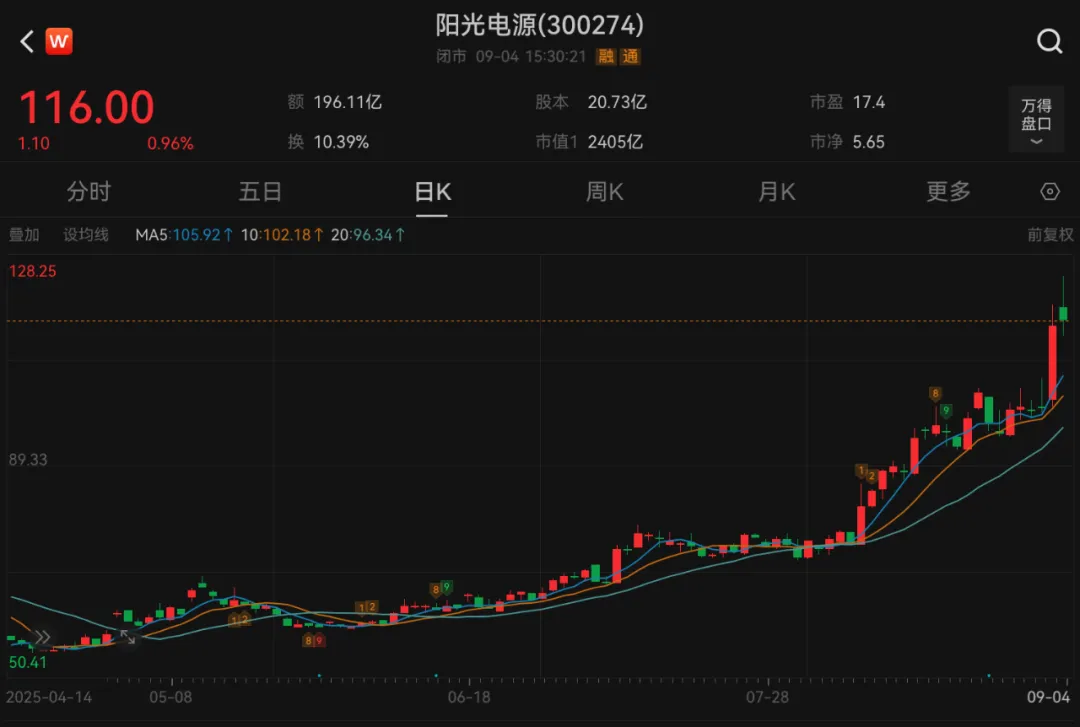
Sungrow's energy storage business revenue reached 17.803 billion yuan in the first half of the year (a year-on-year increase of 127.78%), accounting for 40.89% of total revenue, surpassing its photovoltaic business for the first time. At the end of July, the company secured a major 2.4GWh energy storage order in Europe, marking its first entry into the Bulgarian market.
Ruipu Lanjun shipped 18.87GWh of energy storage batteries in the first half of the year (up 119.3% year-on-year), achieving a capacity utilization rate of 90%, with full capacity reached in July. The company plans to increase the proportion of overseas revenue to 30% by the end of the year.
Leading companies reap the benefits, while small and medium-sized enterprises reap the benefits.Amidst the market reversal, industry profit patterns have diverged significantly.
Cheng Luming, head of the industry research department at Huaan Yuanjian Investment Consulting (Beijing) Co., Ltd., analyzed that leading companies maintain gross profit margins above 20% thanks to technological barriers and overseas channels. CATL's energy storage business revenue has risen to 25%, with overseas orders accounting for over 40%. Haichen Energy Storage's Middle East project achieved a record-high gross profit margin of 28%.
In contrast, small and medium-sized enterprises are caught in a vicious competition of "trading price for volume." By May 2025, the average winning bid price for domestic energy storage systems fell to 0.38 yuan/Wh, with some project bids even below cost. System integrators' profit margins have been squeezed, while the battery cell segment, due to its high technical barriers, retains bargaining power.
Despite short-term supply and demand imbalances, the industry remains vigilant about medium- and long-term risks.
Overcapacity concerns: Starting in the fourth quarter of 2025, planned new domestic production capacity will be released in a concentrated manner. It is expected that the industry's total capacity will exceed 800GWh in 2026, potentially triggering another price war. Overseas policy risks: US tariff barriers, stricter European carbon footprint certification, and "hidden barriers" in the Middle Eastern market (such as local content requirements) may impact Chinese companies' overseas expansion.
Technological substitution pressure: If new technologies such as solid-state batteries and flow batteries accelerate commercialization, existing lithium iron phosphate production capacity may be eliminated.
Faced with a complex landscape, leading companies are accelerating their global expansion. Expansion plans from companies like China New Energy and BYD indicate that new capacity will be released in a concentrated manner starting in the fourth quarter of 2025. Some institutions predict that the industry's total capacity will exceed 800GWh by 2026. CATL's Hungarian factory and EVE Energy's Malaysian base will begin operations in 2026. Haichen Energy Storage plans to build 56GWh of new capacity in Indonesia, aiming to increase the proportion of overseas revenue to 50%.
Technologically, the industry is shifting from a "capacity race" to "comprehensive performance optimization." Innovations such as AI algorithms optimizing energy storage scheduling and grid-connected energy storage supporting grid stability will become the focus of competition in the next phase.
This reversal is essentially a shift in the market from unregulated growth to value competition. Only companies with comprehensive capabilities across the entire technology, cost, and service chain will be able to remain victorious in the global energy transition.

